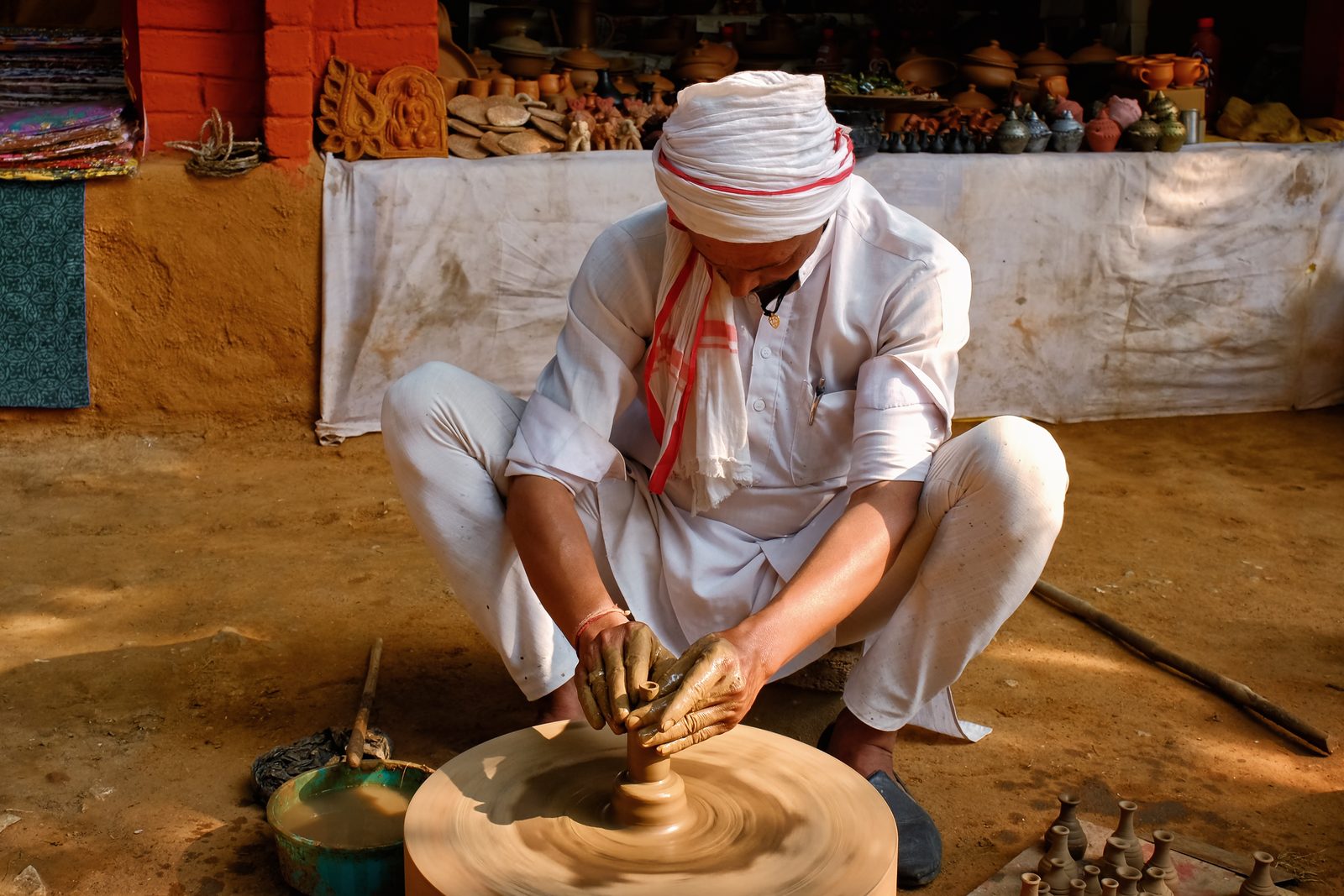
Long before the word “apprenticeship” entered management literature, India had already perfected the technology. Consider the gurukul, the ustad-shagird lineage of the northern ateliers, the sthapati traditions of the southern temple builders, the family workshop where a child absorbed a craft the way one absorbs a mother tongue. These were education systems of extraordinary sophistication. They produced the bronzes of the Cholas, the weaves of Varanasi, the miniatures of the Rajput courts.
They had one economic flaw: they assumed the craft could feed the household. When that assumption broke in the twentieth century, the pedagogy broke with it, not because it stopped working as education, but because families could no longer afford its patience.
Keep the pedagogy, fix the economics
The Skill Center idea begins from a simple diagnosis: the old way of learning was right, and the old economics were the only thing wrong. So we keep what worked (the master at the centre, learning by doing, standards enforced by lineage pride rather than inspection) and we repair what failed:
- The master is paid as faculty. Transmitting a craft is skilled work; it deserves a salary, a title and public honour.
- The learner is paid to learn. Stipends and production-linked earnings mean choosing a craft no longer taxes a family that cannot afford idealism.
- Mastery becomes a credential. Training maps to recognised skill qualifications, so ten years at the wheel counts for something on paper anywhere in India.
- The workshop faces the market. Design, quality and a live marketplace channel are built in from day one, so the craft earns while it teaches.
“We are not modernising the gurukul so much as paying its bills, which is what modernity should have done a century ago.”
Why physical centres, in the clusters themselves
Skill lives in bodies and places, not in videos. A Kanchipuram weave cannot be learned from a screen, and a cluster’s ecosystem of dyers, twisters and loom mechanics cannot be relocated to a city campus without killing what makes it alive. So the centres go to the craft. Each one strengthens an existing cluster: sourcing its masters locally, training its youth locally, and returning its income locally. Success is measured in one number above all: whether more young people enter the craft each year than leave it.
That number has been falling for decades, in every census, in nearly every craft. The Skill Center exists to turn it around, cluster by cluster, until the ancient way of learning is once again a first-class way of living. Read more about the vision on our Skill Centers page.